Diamond Heart Ring with Moving Center Diamond, 0.15tcw | 14kt White Gold
$1,850.00
Gold Diamond Jewelry


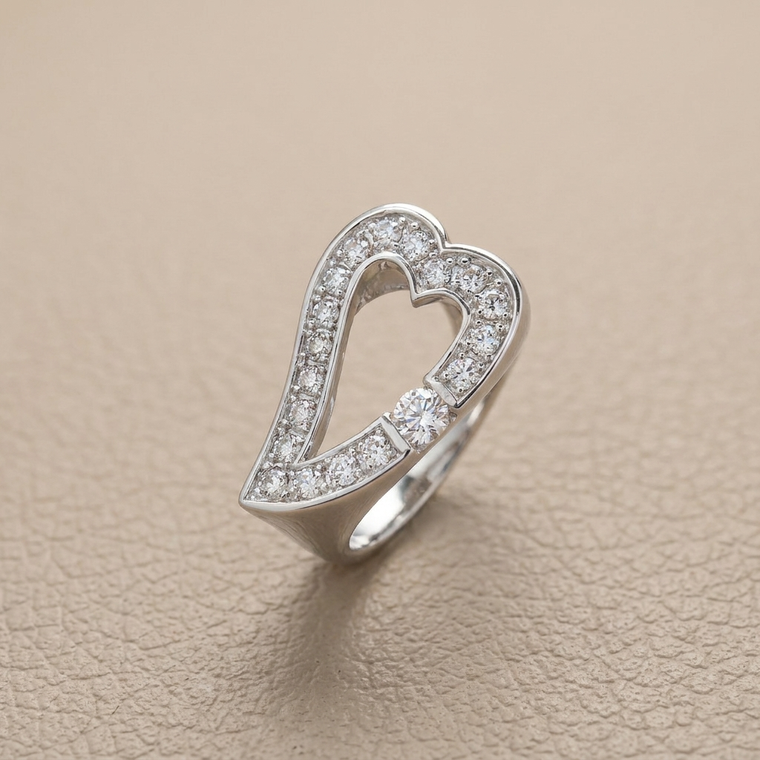
A substantial open heart statement ring built around 8.15g of solid 14kt white gold, with a 13.25mm profile that delivers full finger presence and architectural weight. The open heart silhouette is finished in a pavé treatment across the entire visible face, producing a continuous sparkle surface that reads from across a room. This is a statement piece built for buyers who value the metalwork, the weight, and the scale. SKU: AJGR-0187. $1,625.
The value in this ring lives in the metal. 8.15g of 14kt white gold at 585 purity is substantially heavier than a typical fashion ring, which generally weighs between 3 and 5 grams. The 13.25mm profile thickness gives the ring a bold, architectural presence on the hand, the kind of scale that registers across a table or a room rather than requiring close inspection. The construction is solid gold throughout, not gold-plated or gold-filled. This is jewelry that feels the weight it looks.
14kt white gold is the industry standard for durable fine jewelry, alloyed for strength while retaining the cool metallic tone that makes white gold read as "white." The ring is rhodium-finished, standard for white gold pieces, which is what gives the metal its bright reflective surface.
The heart is rendered as an open, asymmetrical swirl rather than a closed solid form. The negative space inside the heart is intentional — it creates visual rhythm, catches light differently than a closed design, and keeps the ring from feeling overly dense despite the 13.25mm profile. The asymmetry in the loop is part of the design language: the two halves of the heart don't mirror exactly, which keeps the eye moving across the ring.
The entire visible face of the ring carries a pavé finish — small stones set flush across the metal surface to create a continuous sparkle rather than a single focal gem. The stones in this ring are cubic zirconia (CZ), chosen as a finish treatment rather than as the piece's value driver. The decision to use CZ rather than diamonds here is deliberate: at 14kt white gold pavé density across this scale of ring face, a diamond finish would push the piece into four- and five-figure territory. CZ provides the same visual brilliance as a finish element, which is the role it plays here.
This ring is designed for the buyer who wants a bold white gold statement piece and values the substantiality of the metalwork over stone authenticity. It suits fashion-forward self-purchasers who already own fine jewelry and understand the distinct role of a statement ring in a wardrobe — not a daily-wear piece, not a sentimental one, but a presence piece for evenings, occasions, or signature-ring rotation. It also suits gift-givers who want impact at a meaningful fine-jewelry price point without stepping into diamond-territory budgets.
It is not designed for buyers who want a diamond ring, buyers shopping for engagement or wedding jewelry, or buyers looking for a subtle everyday piece. The scale and the stone type are both deliberate choices that define the audience.
A pavé ring (from the French word for "paved") is a jewelry design in which small stones are set flush across the metal surface, creating the visual effect of a continuous sparkle treatment rather than a single focal gem. Pavé is used across fine jewelry to add light and dimension to larger metal forms, and it works particularly well on bold architectural pieces like statement rings where the pavé treatment carries across a substantial visible area. The open heart silhouette in this ring uses pavé as a finish across the entire visible face, giving the ring a continuous light-catching surface. The stones in this particular piece are cubic zirconia (CZ), chosen deliberately as a finish treatment rather than as the ring's value driver — the piece is built around its 8.15g solid 14kt white gold construction and bold 13.25mm profile, with pavé providing the visual sparkle element. Pavé finishes appear across the industry in both diamond and CZ form, and the choice between the two typically reflects the overall price positioning of the piece.
Gold Diamond Jewelry


Gold Diamond Jewelry