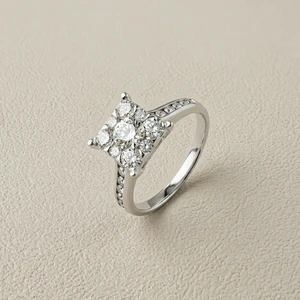

1 Carat Diamond Cluster Engagement Ring — 14kt White Gold | Round Natural Diamonds
$1,800.00
Engagement Rings


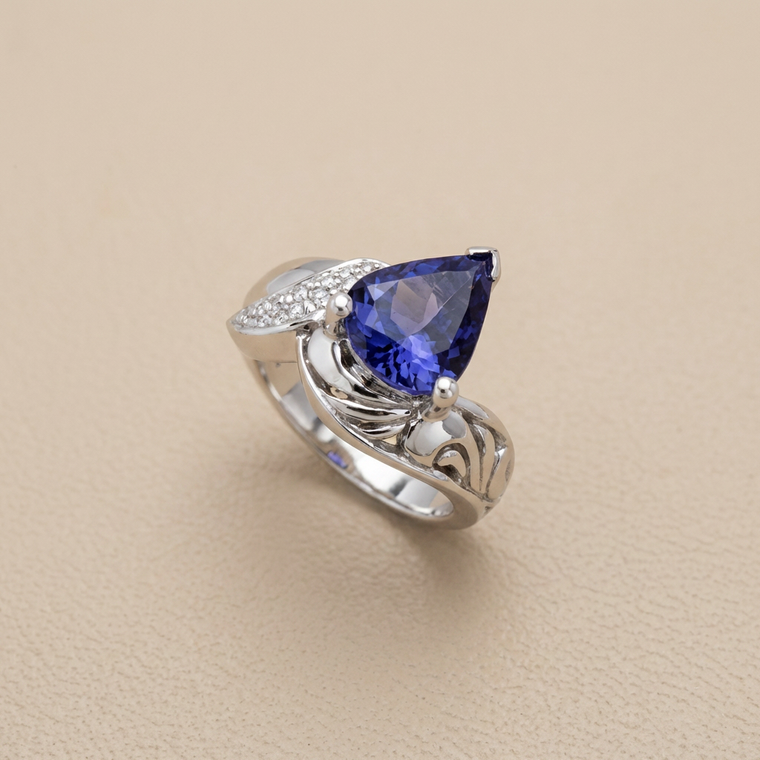
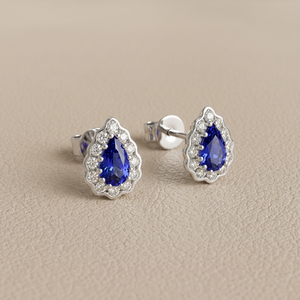
A pear shaped tanzanite & diamond ring in 14kt white gold — 1.69 carats of genuine natural tanzanite at the center, cut in a brilliant pear (teardrop) shape that elongates the finger and showcases the stone’s signature blue-violet color from two directions at once. A 0.10tcw halo of round natural diamonds frames the center stone for a total carat weight of 1.79tcw. G/H color, SI1/SI2 clarity accents. Tanzanite is found in exactly one place on earth — a small deposit near Mount Kilimanjaro in Tanzania — making this stone roughly a thousand times rarer than diamond. $1,050. SKU: AJDGR-0035.
Tanzanite is one of the few gemstones in the world sourced from a single location: a roughly 14-square-mile zone at the foot of Mount Kilimanjaro in northern Tanzania. Existing deposits are projected by geologists to be depleted within a generation, which is why tanzanite is considered rarer than diamond by a factor of approximately one thousand. This particular stone is a 1.69-carat pear cut — a shape that elongates visually on the finger and displays tanzanite’s characteristic trichroism (its color-shift from blue to violet to burgundy depending on viewing angle) along two axes of the stone simultaneously. It is 100% natural and genuine — not synthetic, not simulant, not glass, and the color has not been chemically altered.
Surrounding the tanzanite is a 0.10tcw arrangement of natural round brilliant diamonds in G/H color and SI1/SI2 clarity. G/H places these accents in the near-colorless range where the white gold setting reads as bright and clean. SI1/SI2 clarity keeps the specification practical for an accent role — inclusions in stones this small are not visible to the naked eye in normal viewing conditions. The diamonds provide just enough sparkle to frame the center stone without competing with it — the tanzanite remains the visual focus, with the diamonds acting as a frame that pulls light across the ring face.
This ring is set in solid 14kt white gold, stamped 585 for purity, with a total metal weight of 5.10 grams. White gold is the preferred metal choice for tanzanite for a specific optical reason: the cool, silvery tone of rhodium-plated white gold enhances the stone’s blue component, pushing the color perception toward the deeper violet-blue saturation that collectors look for. Yellow gold, by contrast, can push tanzanite’s apparent color toward gray. White gold also complements the near-colorless diamond accents without the warm overtone that yellow metal would impart. 14kt is durable enough for daily wear while remaining accessible in price compared to 18kt or platinum.
A tanzanite and diamond engagement ring is an increasingly popular alternative to a traditional sapphire or diamond-only engagement ring, in part because tanzanite’s color is unlike anything else in the gemstone world and in part because it carries genuine geological scarcity rather than marketing scarcity. At 1.69ct, this pear tanzanite is substantial enough to carry the visual weight of an engagement ring center stone, and the diamond-accented 14kt white gold setting places it firmly within the style conventions of a contemporary engagement piece. For buyers considering tanzanite as an engagement ring stone, please see the FAQ below on durability and daily wear.
A tanzanite and diamond ring pairs a tanzanite center stone with diamond accents, combining two complementary optical qualities: the saturated blue-violet color of tanzanite with the white brilliance of diamond. Because tanzanite is sourced from a single location on earth and existing deposits are projected to be depleted within a generation, it is considered rarer than diamond. A pear shape tanzanite — also called a teardrop tanzanite — is one of the most elegant cuts for this stone because the elongated outline elongates the finger visually and displays tanzanite’s color-shift property across the full length of the stone. In a 14kt white gold setting, the cool metal tone enhances the blue component of the tanzanite’s color, producing the deep saturated look that defines collector-quality tanzanite.
Engagement Rings

Engagement Rings

Gold Diamond Jewelry