Posted by Treasured & Co. on 8th May 2026
Vintage Emerald Necklace, Natural Colombian & Zambian 10.46tcw
A One-Necklace Spotlight · By the Treasured & Co. Editorial Team · Handcrafted in Astoria, New York · since 1989

- Natural, not lab-created — every stone earth-mined, with origin documentation
- Two documented origins — Colombian and Zambian emeralds on a single chain
- Vintage-style station setting — 18kt yellow gold, 18-inch length, hallmarked
- One of a kind — handcrafted in Astoria, NY · no second one will ever exist
- Free U.S. shipping · 30-day returns · ships insured
A Vintage-Style Emerald Necklace, with Real Stones
Almost every emerald necklace currently for sale online is one of two things: a contemporary mass-produced piece using lab-created stones, or a vintage piece pulled from estate jewelry that you have no way of authenticating. There's a smaller third category that's harder to find: vintage-style construction with new-mounted natural emeralds, sourced and documented by the jeweler who made it. That's what this necklace is.
The composition: 10.46 total carats of natural, earth-mined emerald, set as stations along an 18-inch chain in 18kt yellow gold. The visual reads like an estate piece — the warm gold, the spaced station format that recalls 1970s "by the yard" design, the imperfect hand-feel of stones placed by a person rather than a machine. The provenance reads like a contemporary fine-jewelry piece: documented mining origins, hand-finished by our bench in Astoria, no surprises.
If you've been looking for a real vintage emerald necklace and bouncing off either too-good-to-be-true Etsy listings or unverifiable estate auctions, this is the alternative.
The Detail That Makes It Genuinely Rare
Two natural emerald origins.
One vintage-style necklace.

Natural Colombian + Zambian Emeralds · 10.46 tcw
Look closely at the stones above. The emeralds vary subtly in tone — some lean warmer and deeper green (the Colombian side), some shift slightly cooler and brighter (the Zambian side). Both are natural. Both have visible jardin — the small interior inclusions that confirm earth-formed origin. The dual-origin pairing is what most distinguishes this from any standard emerald necklace; it's also the strongest visible authentication that the stones are real.
On the Neck
How It Wears
The studio shots tell you what the necklace is. This tells you how it actually lives.
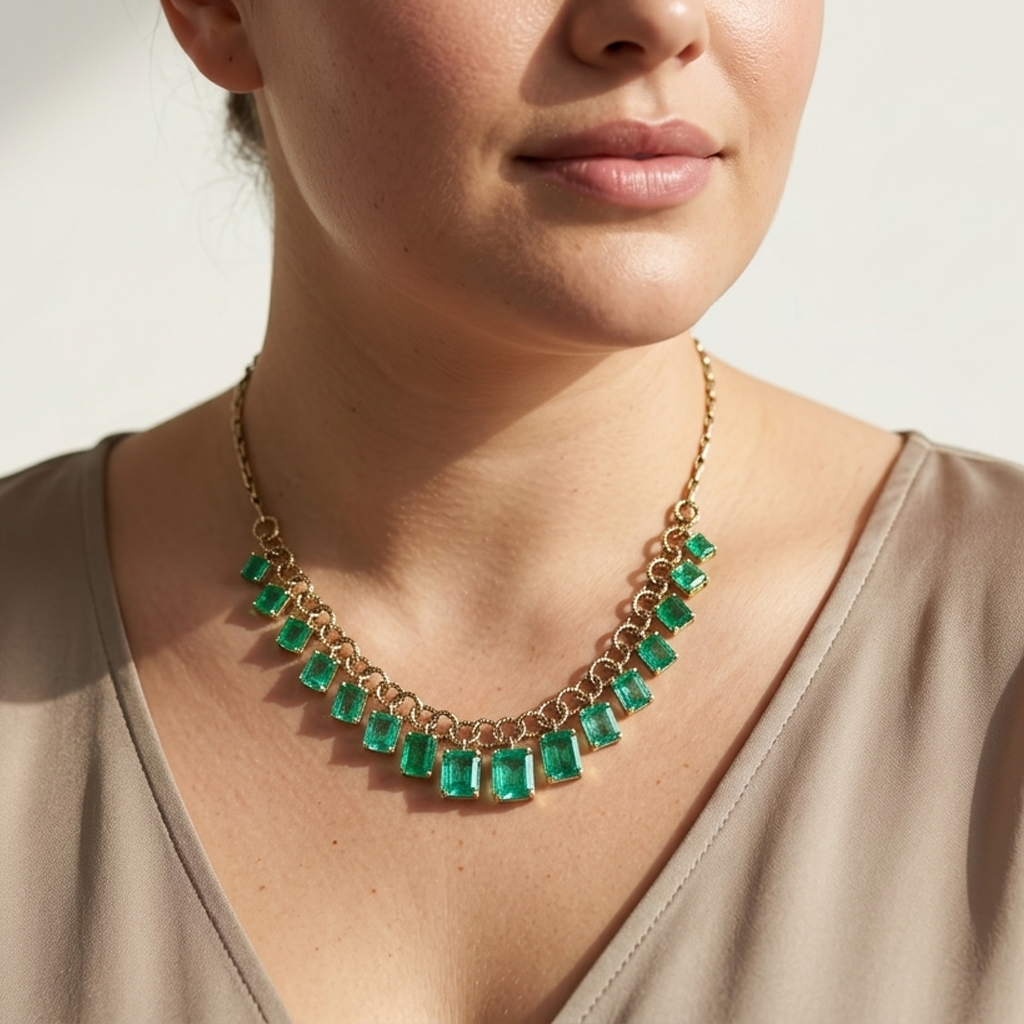 Worn · 18-inch length
 The 18-inch length sits at the collarbone — visible above any neckline that isn't a turtleneck, hidden beneath buttoned shirts when wanted.
Authenticity
How to Know an Emerald Necklace Is Real (and Why It Matters)
A real emerald necklace is one in which every stone is natural — formed in the earth, not grown in a lab. Real natural emeralds carry origin, carat weight, and intrinsic value that lab-created stones, no matter how visually similar, do not. For a buyer spending in the four-figure range or above on an emerald piece, knowing the difference is the most important question to answer before purchase.
The four checks every buyer should run:
The 4-Point Real Emerald Check
- Jardin (visible internal inclusions). Almost all natural emeralds contain small interior patterns — gemologists call them jardin, French for garden. A flawless, perfectly clear emerald at any meaningful carat weight is so rare it's usually either lab-created or a different gemstone entirely (often green glass, peridot, or tsavorite). Visible jardin is a signature, not a defect.
- Mohs 7.5–8 hardness. A real emerald will scratch glass but won't be scratched by a steel blade. Lab-created emeralds match this hardness; glass and softer stones don't.
- Deep, saturated color. Real natural emeralds hold their saturation under different lighting. Color that shifts dramatically or appears to "wash out" under daylight vs incandescent often signals a treated or synthetic stone.
- Documentation. A reputable jeweler ships natural emeralds with origin documentation — country of origin, mining region when known, treatment disclosure, and (for major stones) an independent gemological certificate.
Every natural emerald in this necklace is documented. The Colombian stones are sourced from the Muzo and Chivor regions; the Zambian stones from the Kafubu mining region. Both sets carry the visible jardin you'd expect from genuine earth-mined emeralds. The piece ships with origin documentation included.
The Two Origins
Colombian Emeralds vs Zambian Emeralds
For most of jewelry history, "emerald" meant Colombian emerald. The Muzo, Chivor, and Coscuez mines east of Bogotá produced — and continue to produce — the most saturated green stones in the world. By the time Cleopatra was wearing emeralds, they were almost certainly Egyptian; by the time the Spanish reached the Americas, the world had a new gold standard, and the gold standard was Colombia.
Zambia changed the conversation in the 1970s. The Kafubu mining region produced commercial emerald supply that was visually distinct: cooler-toned, often clearer, frequently with fewer of the natural inclusions that Colombian emeralds carry. Today Zambian emeralds account for roughly 20% of global production and are increasingly the choice for designers who want luminosity over depth.
This necklace pairs both. Side by side. On a single chain.
?? Colombia
The Classical Origin
Deep, saturated, warm green — the historical reference standard. Natural inclusions ('jardin') confirm earth-mined origin. The emerald color most jewelry shoppers picture when they hear the word.
?? Zambia
The Luminous Modern
Cooler-toned, often slightly bluer-green, generally clearer. Reads brighter under light. The growing favorite for collectors and designers seeking high clarity at substantial carat weights.
The Setting
What Is a Station Necklace?
A station necklace sets gemstones at intervals along a chain rather than continuously. The stones — the "stations" — are separated by sections of plain chain, so each one reads individually rather than dissolving into a single line of color the way a tennis necklace does.
The format originated in 1974 when Elsa Peretti designed the Tiffany "Diamonds by the Yard" collection — a string of single diamonds spaced along a yellow gold chain. The design shifted how fine jewelry could read: quietly individual, daily-wearable, mathematically simple. A station necklace photographs as a series of points; on the body, it moves with the wearer instead of fighting against the neckline.
For a real natural emerald necklace specifically, the station format does something a continuous tennis-style setting can't: it lets each stone be inspected individually. Each emerald keeps its own color identity, its own jardin, its own provenance. The dual-origin contrast — Colombian green next to Zambian green — is only visible because the stations create separation. On a continuous setting this nuance would disappear.
The Metal
Why Vintage Emerald Necklaces Are Set in 18kt Yellow Gold
18kt (75% pure gold) is the historical standard for fine emerald jewelry — and the metal you'll find on virtually every authentic vintage emerald piece in estate collections. 24kt pure gold is too soft for daily wear; 14kt at 58.3% gold reads slightly less saturated and more pale. 18kt sits in the sweet spot: deep enough in color that it photographs as unmistakably gold, hard enough that the chain links and bezel-set stations survive decades of wear.
For green emeralds specifically, the choice of yellow gold (vs white gold) is deliberate. White gold cools the green and brightens it — modern but less period-correct. Yellow gold warms the green and reinforces the heirloom positioning. This piece commits to the warmer, traditional reading. It looks like it could have come out of an estate jeweler's case in 1974.
The Full View
The Necklace, Studied Closely
Four shots at full resolution — the entire piece, the close detail, the angle, and the laid-flat front view.


Specifications
| Stones | Natural Colombian and Zambian emeralds (earth-mined, real) |
|---|---|
| Total carat weight | 10.46 ct |
| Setting | Vintage-style station necklace · bezel-set stones along chain |
| Metal | 18kt yellow gold (hallmarked) |
| Length | 18 inches (resizable to 16″ or 20″) |
| Crafted in | Astoria, New York · by hand · since 1989 |
| Documentation | Origin documentation included for both Colombian and Zambian stones |
| Treatment | Standard industry oil treatment disclosed (typical for natural emeralds) |
| Resizing | One free length adjustment within 60 days |
| Shipping | Free across the U.S. · ships insured · expedited available |
| Returns | 30 days, unworn condition |
| One of a kind | Yes — when this piece sells, it will not be re-made |
Who Buys a Real Vintage Emerald Necklace at This Tier
The buyer who commits to a $6,995 natural emerald necklace usually fits one of three profiles. The first is a person buying for an anniversary or milestone — a 25th, 30th, or 40th — where the recipient has reached a point in life that warrants something the same person at thirty wouldn't have considered. The second is a self-purchase by someone who's owned enough fine jewelry to know the difference between a contemporary mass-produced emerald piece and a real one. The third is an estate-planning gift: an heirloom commissioned now to be passed down later.
What all three buyers have in common: they want a real natural emerald, they want documented provenance, and they want a piece that's vintage-style enough to still read as fine jewelry in 30 years rather than dating to a particular trend cycle. This necklace is built for that buyer.
If you're researching vintage emerald necklaces and want to compare against what's typically on the market — the Colombian-only auction pieces at $20,000+, the Zambian-only contemporary pieces at $4,000–$8,000, the antique estate listings of unverifiable origin — the dual-origin combination here is genuinely unusual and gets you a heirloom-grade piece at the lower edge of the natural-emerald price tier. We can document this. Most listings can't.
Frequently Asked Questions
How can I tell if an emerald necklace is real?
Four checks: visible jardin (natural inclusions), Mohs 7.5–8 hardness, deep saturated color that doesn't shift in different lighting, and origin documentation from the seller. Flawless emeralds at significant carat weight are usually lab-created or a different stone (peridot, tsavorite, glass).
What's the difference between a natural and lab-created emerald?
Natural emeralds form in the earth over millions of years and carry origin and provenance. Lab-created emeralds are chemically identical but grown in weeks, with no documented mining region. Natural emeralds appreciate in value; lab-created ones generally don't. This necklace contains only natural emeralds.
Are vintage emerald necklaces worth more than new ones?
Vintage and antique emerald necklaces — those with documented age, provenance, and traditional craftsmanship — often appreciate more reliably than newly-made pieces. This necklace is vintage-style construction with new-mounted natural emeralds, capturing heirloom aesthetics at a more accessible price than antique-market pieces of comparable carat weight.
What does "natural" emerald mean?
A natural emerald is one that formed in the earth (not grown in a lab). Almost all natural emeralds receive minor industry-standard oil treatment to reduce visible surface inclusions — disclosed when present. The emeralds in this necklace are natural and sourced from documented Colombian and Zambian mines.
What is a Colombian emerald?
An emerald mined in Colombia — primarily the Muzo, Chivor, and Coscuez regions east of Bogotá. Considered the historical gold standard for emerald color: deep, saturated, warm green. ~70% of the world's finest emeralds historically came from Colombia.
What is a Zambian emerald?
An emerald from Zambia's Kafubu mining region (commercial production since the 1970s). Tends to be cooler-toned, slightly bluer, often with fewer inclusions than Colombian. Now ~20% of global emerald supply.
What is a station necklace?
A necklace where gemstones are spaced at intervals along a chain rather than set continuously. Each "station" reads individually. Originated as Elsa Peretti's 1974 "Diamonds by the Yard" design for Tiffany.
How much is a real emerald necklace worth?
Real natural emerald necklaces range from ~$800 for a single-stone pendant to $50,000+ for substantial Colombian pieces. This 10.46tcw piece is $6,995. Comparable single-origin Colombian emerald pieces at major auction houses regularly reach $15,000–$50,000 for similar carat weights.
Are emeralds durable enough for daily wear?
Mohs 7.5–8 — durable enough, slightly softer than diamonds (10) or sapphires (9). For a station necklace specifically, daily wear is fine because the stones don't sit at impact points. Avoid steam and ultrasonic cleaners.
Can this necklace be shortened or lengthened?
Yes. Standard length is 18 inches. We can shorten to 16″ or extend to 20″ at workshop cost. Station necklaces are among the easiest to resize.
Where is this necklace made?
Handcrafted in our Astoria, New York workshop, where Treasured & Co. has operated since 1989. Free U.S. shipping; in-person fittings by appointment at 30-06 Steinway St.
One of a Kind · Currently Available
Vintage-Style Natural Emerald Station Necklace
10.46 tcw · Real Colombian + Zambian · 18kt Yellow Gold
Reserve This Necklace →A real, natural, vintage-style emerald necklace. Two origins, one chain.
The kind of piece you don't replace — you pass it on.
All Emerald Necklaces Emerald Bracelets All Pendant Necklaces Gemstone Pendants Unique Pieces