Posted by Treasured & Co. on 26th Apr 2026
Sapphire Engagement Rings: A Buyer's Guide | Treasured & Co.
Sapphire &
The Modern Engagement
Three signature rings. Three colors. One enduring gemstone. A complete guide to choosing a natural sapphire engagement ring — with provenance, certification, and craft you can verify.
A stone of consequence,
not a passing trend.
Sapphire engagement rings aren't just having a moment — they're redefining what a meaningful, lasting commitment looks like. The royal lineage runs from Princess Diana's eighteen-carat oval to Catherine, Princess of Wales. The science runs deeper still: corundum, rated 9 on the Mohs scale, second only to diamond. The result is a stone with the symbolism of generations and the durability for daily wear.
Three rings, three stories.
Hand-selected from our atelier. Each piece is GIA-eligible, ethically sourced, and ready to ship from our Astoria, NY workshop.
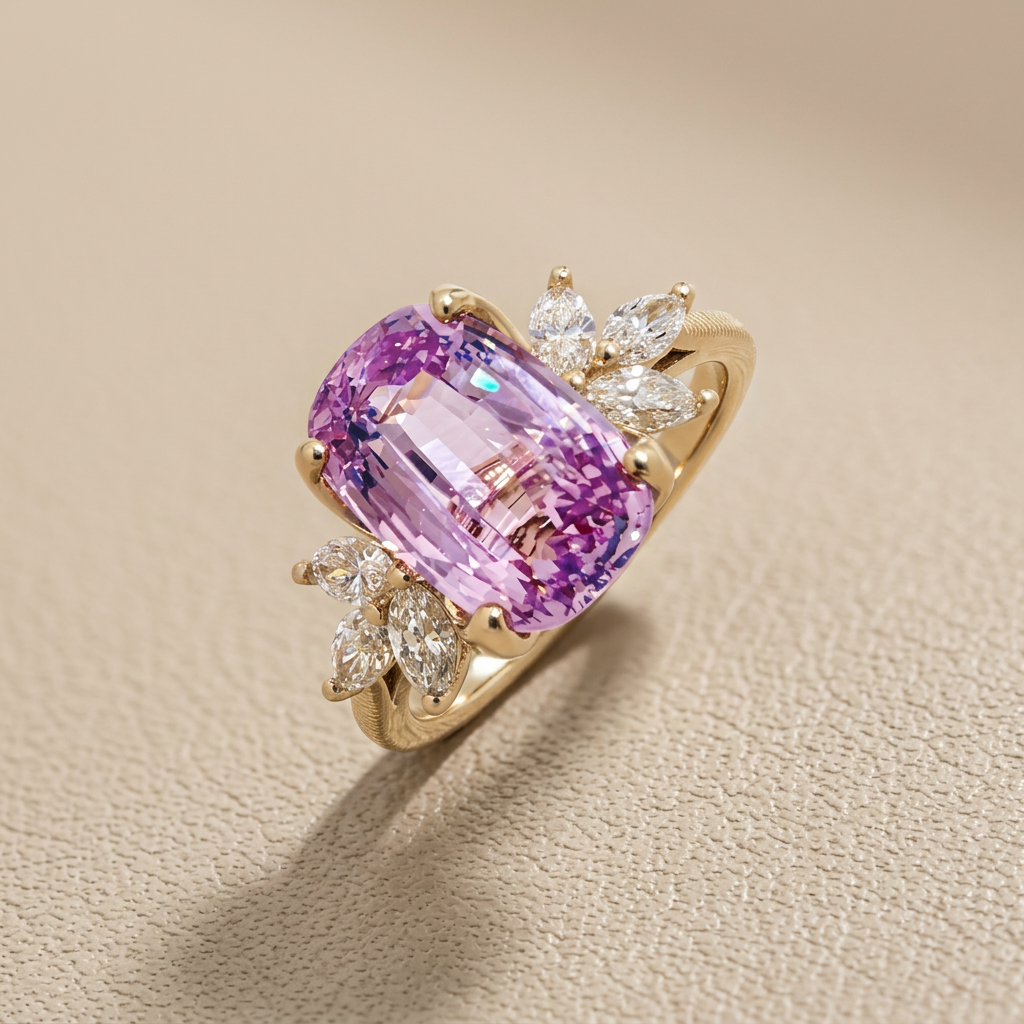
Natural Pink Sapphire 3.02ct
A GIA-certified, unheated cushion-cut Ceylon pink sapphire flanked by F/VS marquise diamonds in 14kt gold. SKU AJENG-0023.

Green Sapphire Oval Three-Stone
A 2ct natural green sapphire flanked by tapered baguette G/H, SI1/SI2 diamonds in 14kt white gold. SKU AJENG-0029.

Vintage Oval Sapphire & Diamond
A 1.55ct natural oval sapphire centerpiece with marquise diamond and round sapphire accents — 3.10tcw — in 14kt white gold. SKU AJENG-0030.
See each ring come to life.
Color reads differently in motion. Watch how light moves across each stone — the way it would on the hand of someone who wears it every day.
Natural Pink Sapphire 3.02ct
Cushion · Sri Lanka · Unheated
$8,500 View Ring → Green Sapphire Oval Three-Stone
Oval · 3-Stone · 14kt White Gold
$2,650 View Ring → Vintage Oval Sapphire & Diamond
Oval · 3.10tcw · 14kt White Gold
$2,400 View Ring →What does a sapphire engagement ring mean?
Sapphire engagement rings have long symbolized loyalty, wisdom, and enduring devotion. The royal tradition has cemented sapphire as a symbol of romantic legacy and lasting commitment.
For centuries, sapphire was the gemstone of clergy, royalty, and statecraft — a stone associated with truth, fidelity, and the heavens. Medieval kings wore sapphires believing the stones would protect them from envy and harm. By the time Prince Charles placed an eighteen-carat oval Ceylon sapphire on Diana Spencer's finger in 1981 — a ring later given to Catherine, Princess of Wales — sapphire had already accumulated nine centuries of meaning.
For modern couples, the language is the same and the message is direct: this is a ring meant to last. Sapphire's symbolism is not aspirational; it's accumulated, layered into the stone by generations of people who chose it for the same reasons you might.
Are sapphires good for engagement rings?
Yes. Sapphires score 9 on the Mohs hardness scale, second only to diamonds among gemstones used in fine jewelry. They resist scratching and chipping under normal daily wear and are exceptionally well-suited to engagement rings worn every day.
Hardness on the Mohs scale is logarithmic, not linear — diamond at 10 is meaningfully harder than sapphire at 9, but sapphire at 9 is dramatically harder than emerald or topaz. In practical terms: a sapphire engagement ring will retain its surface polish, prong integrity, and overall appearance for decades of daily wear with only routine professional checks. There is a reason royal heirloom sapphires emerge from vaults and family safes a century later still ready to be worn — the stone simply outlasts the wear of a lifetime.
Four credentials that change a stone's value.
Natural vs. Lab
Both are chemically identical corundum. Natural stones carry geological provenance and long-term value; lab-grown stones offer the same look at 30 to 50 percent less. We curate exclusively natural sapphires.
Heated vs. Unheated
Over 95% of commercial sapphires are heat-treated to enhance color. Unheated stones reach their hue naturally — and command a 30 to 50 percent premium. Both are accepted; only one is rare.
GIA Certification
An independent grading report from the Gemological Institute of America documenting color, clarity, origin, and treatment status. The single most important piece of paper in a sapphire purchase.
Ceylon Origin
Sapphires mined in Sri Lanka — historically known as Ceylon — are prized for their luminous, velvety hues and exceptional clarity. Origin alone can meaningfully increase value, particularly when GIA-documented.
Color is the soul of a sapphire.
A grading report can tell you what a stone is. Only color can tell you what it means.

Romance and rarity.
Pink sapphires occupy a uniquely romantic space — colored by trace chromium, the same element that produces ruby, ranging from delicate blush to vivid magenta. True pink sapphires with strong, even saturation are genuinely scarce. They carry a quiet prestige that doesn't lean on the conventional diamond aesthetic.
Our 3.02ct natural pink sapphire from Sri Lanka is GIA-certified unheated — a distinction the GIA grants only to stones with no diagnostic features of heat treatment.
Shop the Pink Sapphire →
Earthy elegance.
Green sapphires offer something genuinely uncommon — colored by trace iron, ranging from soft sage to deep forest. Their grounded, nature-inspired character appeals to couples drawn to organic aesthetics rather than the conventional. Mohs 9 hardness, full daily-wear durability, distinctive personality.
Our 2ct natural green sapphire is set in a three-stone composition with tapered baguette G/H, SI1/SI2 diamonds in 14kt white gold — past, present, and future, expressed in a stone you'll see almost nowhere else.
Shop the Green Sapphire →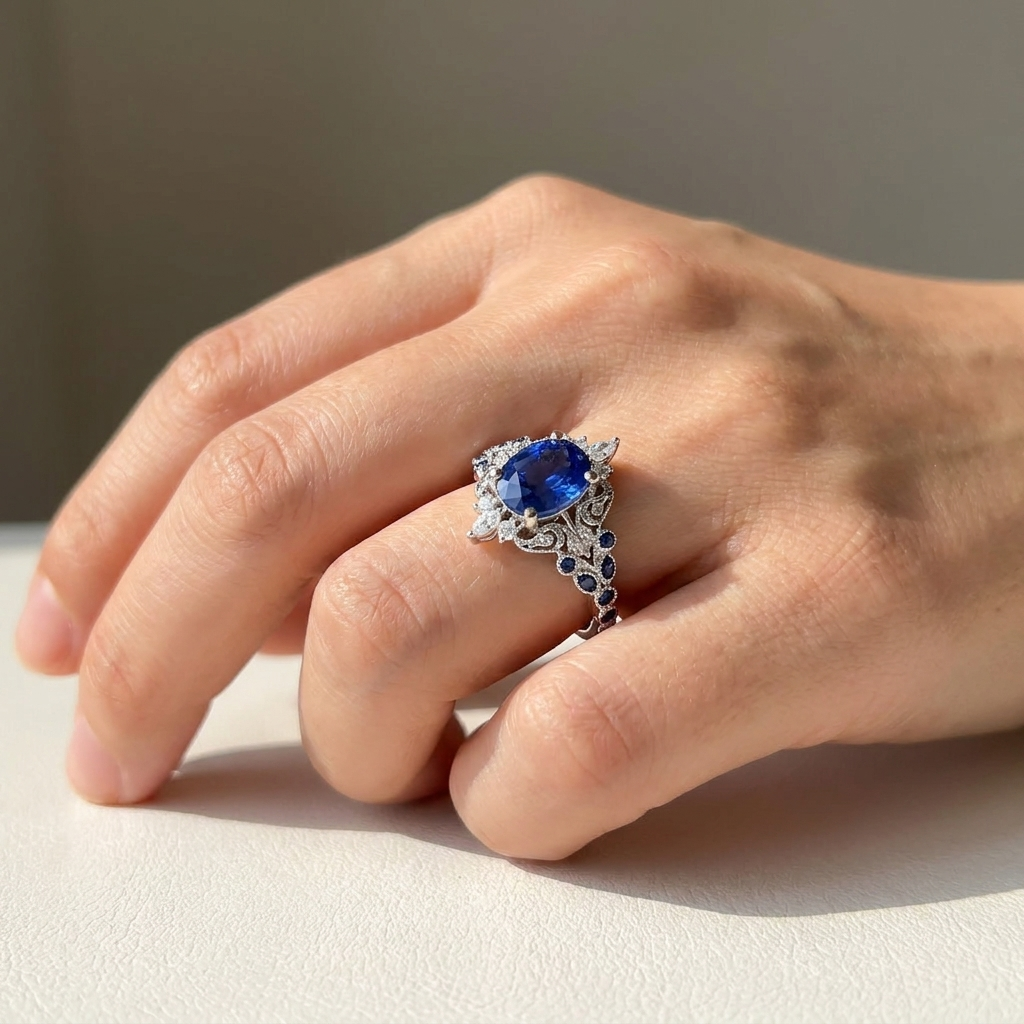
Timeless heirlooms.
Blue sapphires remain the definitive choice for a reason. Symbolizing loyalty, wisdom, and enduring devotion, they have graced royal hands and heirloom settings for centuries. Vintage-inspired settings lean into this lineage with marquise and round accents that recall Edwardian and Art Deco craftsmanship.
Our vintage piece pairs a 1.55ct natural oval sapphire centerpiece with marquise diamonds and round sapphire accents — 3.10tcw total — in 14kt white gold. Tomorrow's heirloom, available today.
Shop the Vintage Sapphire →Cushion, oval, and beyond.
Unlike diamonds, where a standardized brilliant cut dominates, sapphires are shaped with flexibility — cutters prioritize color retention and visual depth over rigid proportional formulas.
Cushion cut — soft, rounded corners give cushion sapphires a romantic, vintage character ideal for warmer hues like pink and padparadscha. Our 3.02ct pink sapphire features a cushion brilliant crown with a step-cut pavilion, delivering both color depth and exceptional light return. View the cushion cut pink sapphire →
Oval cut — the most flattering everyday choice. Its elongated silhouette makes fingers appear longer and draws color evenly from corner to corner. Both our green sapphire (three-stone setting) and our vintage piece (marquise accent setting) feature oval centers.
Round, princess, and pear — bolder, more architectural alternatives. Round delivers maximum brilliance when the stone is exceptional; pear and marquise give a distinctive silhouette that suits buyers who want something unmistakable.
Three-stone, halo, and pavé.
Pairing sapphires with diamonds is one of the most time-tested strategies in fine jewelry. Colorless brilliance amplifies color saturation rather than competing with it.
Three-stone rings place a center sapphire between two flanking diamonds, creating a balanced composition with instant visual drama. The layout carries symbolic meaning — past, present, and future — that resonates with couples seeking both aesthetics and intention. Our green sapphire three-stone ring uses tapered baguette diamonds, a deliberate Art Deco gesture that flatters the elongated oval center.
Halos and accent diamonds intensify the perception of color saturation through contrast. Vintage-inspired settings use this technique alongside marquise and round accents to evoke Edwardian and Art Deco craftsmanship — exactly the approach in our 3.10tcw vintage sapphire and diamond ring, where the central oval is framed by both marquise diamonds and round sapphire accents.
Sapphire vs. diamond engagement rings.
| Quality | Sapphire | Diamond |
|---|---|---|
| Mohs Hardness | 9 — exceptional, suited to daily wear | 10 — the hardest known mineral |
| Color Range | Blue, pink, green, yellow, padparadscha, parti, and more | Colorless to faintly tinted; fancy colors are rare and costly |
| Symbolism | Loyalty, wisdom, fidelity — royal heritage | Eternal commitment, traditional engagement icon |
| Rarity (per carat) | Unheated, GIA-certified, premium origins are genuinely rare | High-quality stones common; truly exceptional ones rare |
| Price (per carat) | Generally lower than equivalent-quality diamonds | Higher per carat; fancy colors significantly more |
| Distinctiveness | Immediately recognizable as a deliberate, personal choice | Familiar; depends on cut and setting for individuality |
How much does a sapphire engagement ring cost?
Natural sapphire engagement rings typically range from about $1,500 for smaller, heated stones in simple settings to $20,000 or more for unheated, GIA-certified stones from premier origins.
What drives the price: origin (Kashmir, Burma, and Sri Lanka command premiums), treatment status (unheated stones command 30 to 50 percent premiums over heated equivalents), color saturation and tone (vivid, evenly saturated stones are dramatically more valuable than pale or zoned ones), carat weight, and setting metal and side stones (platinum, diamond accents, and complex settings add cost).
Our curated collection spans roughly $2,400 for the vintage oval to $8,500 for the GIA-certified unheated Ceylon pink sapphire — every piece focused on natural stones with verifiable provenance. Financing through Affirm is available on every ring.
What to look for when buying.
- Independent certification — GIA, AGL, or equivalent
- Treatment disclosure — heated, unheated, or other
- Origin documentation — country of origin on the report
- Color saturation — vivid, evenly distributed, no windowing
- Cut quality — color visible across the entire face-up
- Setting metal — platinum, white gold, yellow gold, rose gold
- Diamond grades — color and clarity of any side stones
- Return and warranty terms — written, not verbal
Caring for your sapphire.
At Mohs 9, sapphires are exceptionally durable. Smart habits keep them brilliant for decades.
DIY cleaning: soak in warm water with a few drops of mild dish soap for 10–15 minutes, then scrub gently with a soft toothbrush. Rinse and pat dry.
Professional checks: a bi-annual prong inspection catches loose settings before a stone is at risk.
Storage: keep your ring in a soft pouch separated from harder stones (specifically diamonds), which can scratch any other gemstone they touch.
Why buy from us.
- GIA reports on file for premium pieces
- Hand-selected natural stones; no lab-grown
- Family-run atelier in Astoria, NY since 2003
- Free U.S. shipping and 30-day returns
- Affirm financing on every ring
- Private viewings by appointment
- Lifetime guarantee on craftsmanship
- Direct line to the workshop: (718) 956-0001
Frequently asked.
Three rings. Yours to consider.
Each piece is in stock and ready to ship from our Astoria atelier. Or speak with a gemologist for a private consultation.