One of One · GIA N° 1232891350
The Unheated Pink Sapphire Engagement Ring
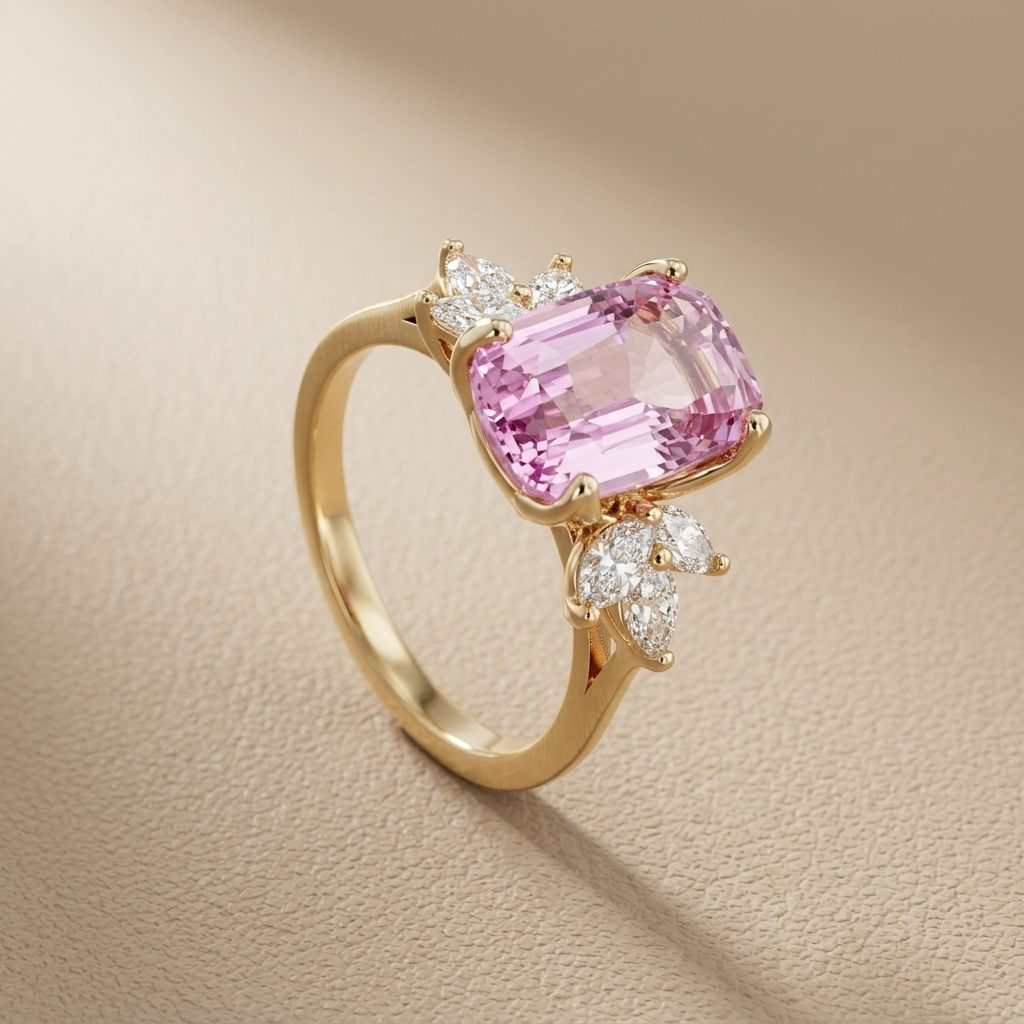
A 3.02-carat cushion-cut pink sapphire from Ceylon that the earth finished on its own — no heat, no treatment, nothing added. Certified by the GIA. Set once, in 14kt gold. When it sells, it will never exist again.
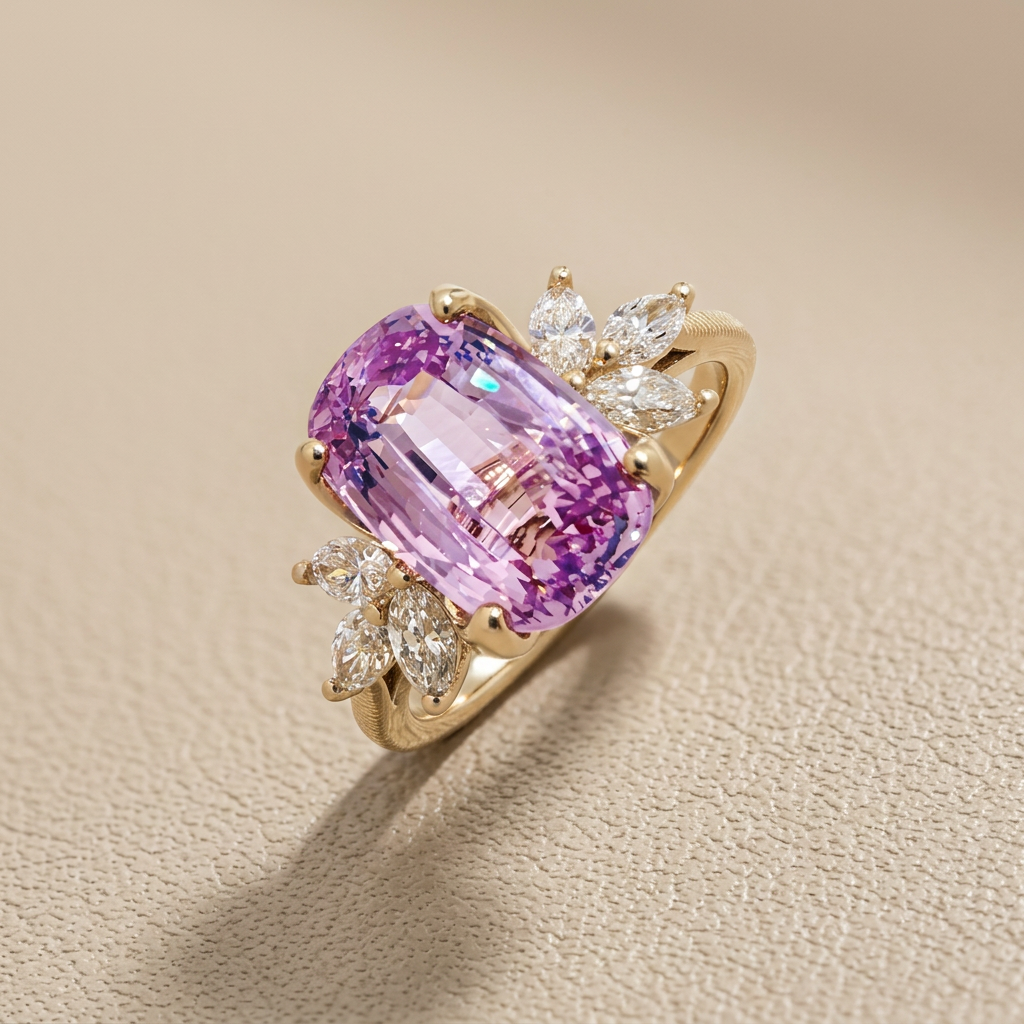
01 — In the Round
Turn the ring yourself
Photographs flatten a stone. Drag the ring to move through nine real studio angles — the crown, the gallery, the prong work, the way the cushion’s facets hold pink from every side. Nothing rendered, nothing retouched into fantasy: this is the actual ring you would own.
Crown, from above
02 — The Word That Changes Everything
What does unheated mean in a pink sapphire?
An unheated pink sapphire is a sapphire whose color and clarity are entirely natural — the stone has never been exposed to the heat treatment used on the vast majority of sapphires sold today. Laboratories like the GIA issue a “no indications of heating” designation only after microscopic and spectroscopic analysis finds no evidence of treatment.
Heat treatment is not a flaw — it is the industry standard. Furnaces push pale stones toward richer color and dissolve the silk inclusions that cloud them. But it also means the color you see was engineered. An unheated stone is different in kind: its pink was fixed in the crystal millions of years ago and has never been altered by anyone. That is why treatment status is, after origin, the single most consequential factor in what a fine sapphire is worth.
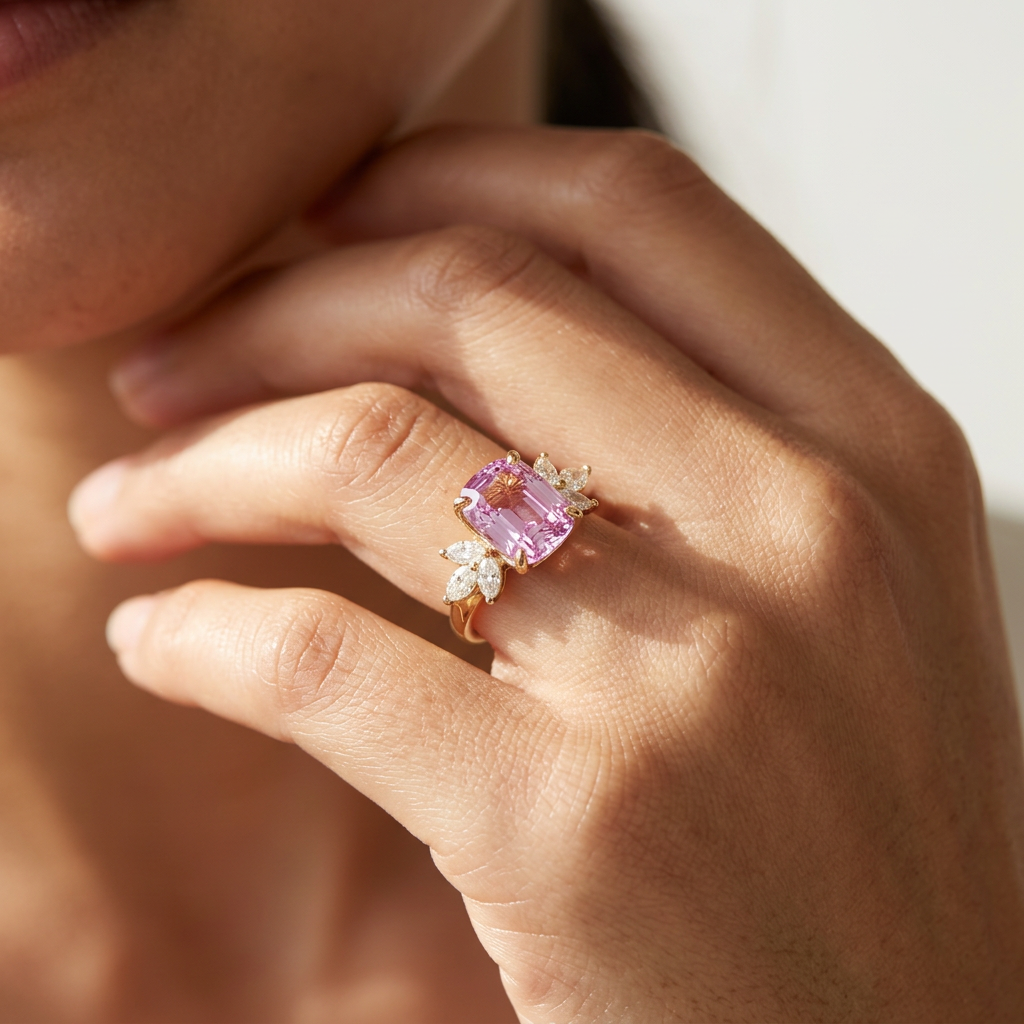
The 3.02 ct Ceylon sapphire, worn
03 — Origin
Ceylon: the oldest name in sapphires
Sri Lanka — Ceylon, in the gem trade’s older language — has produced sapphires for more than two thousand years. Marco Polo wrote about its stones. Royal houses set them. Today, when auction catalogues want to signal pedigree in a pink sapphire, Ceylon is the word they reach for.
The island’s pinks are distinctive: soft, luminous, lit from within rather than saturated to opacity. They share a lineage with the padparadscha — the lotus-colored sapphire that is Ceylon’s most famous export. This stone belongs to that family. Its 3.02 carats were cut as a cushion: rounded corners and broad facets that let the pink bloom evenly across the face, over a step-cut pavilion that returns light in slow, wide flashes rather than nervous glitter.
A natural, unheated Ceylon pink sapphire above three carats is not something a jeweler can reorder. It is found, or it is not.
04 — The Stone, On Paper
Specifications
Every figure below appears on the stone’s GIA Sapphire Origin Report. Nothing here is our opinion.
05 — Trust, Independently
Proof, not promises
Any seller can call a sapphire natural and unheated. Very few invite you to check. This stone carries a GIA Sapphire Origin Report — the most rigorous independent document a colored stone can hold — and you can verify it yourself before you ever contact us:
1. Go to reportcheck.gia.edu, the GIA’s own database.
2. Enter report number 1232891350.
3. Read the GIA’s findings — natural pink sapphire, no indications of heating, Sri Lanka origin — straight from the laboratory.
The original printed report ships with the ring, alongside a Treasured & Co. certificate of authenticity.
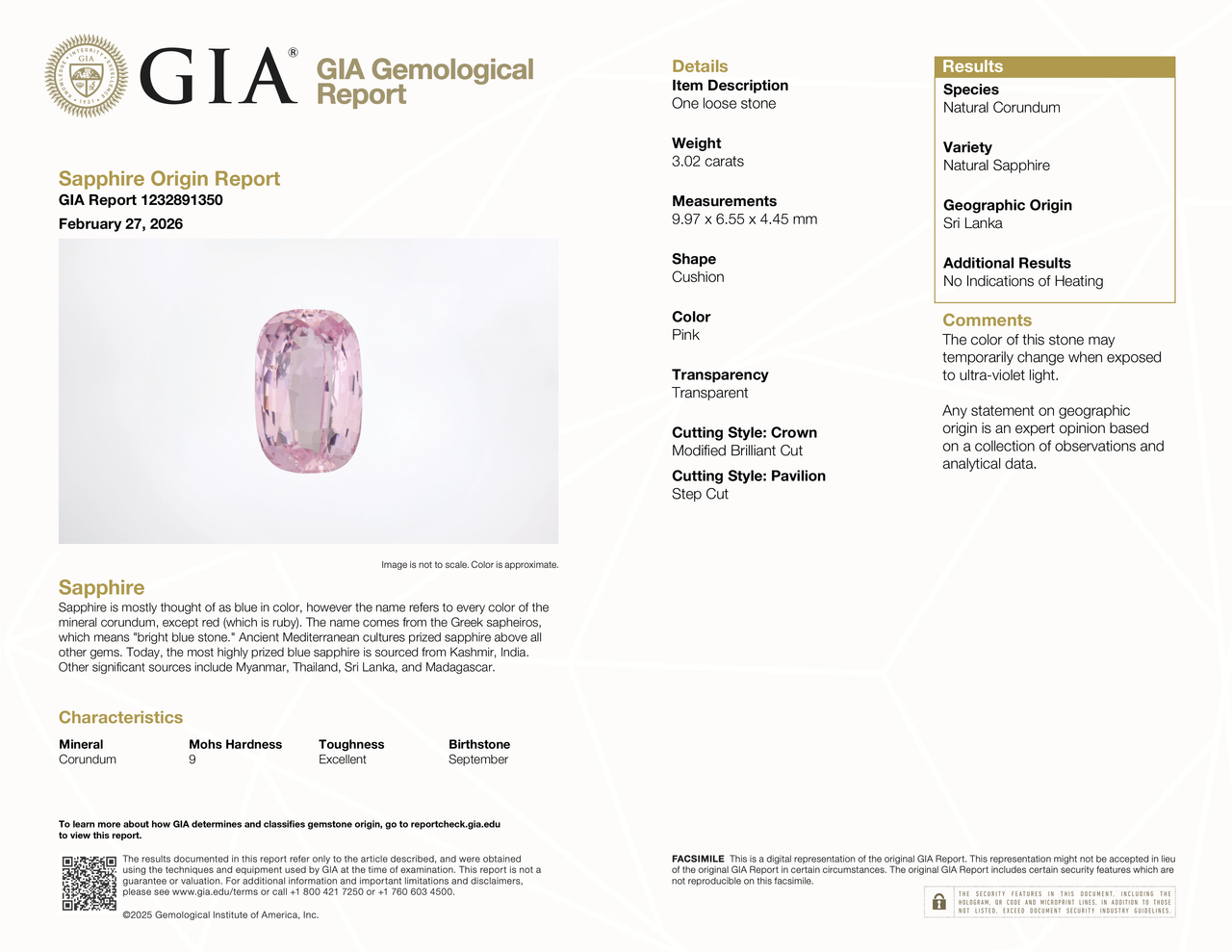
GIA report N° 1232891350 — verifiable online
06 — Side by Side
Heated vs. unheated pink sapphires
| Heated sapphire | Unheated sapphire (this ring) | |
|---|---|---|
| Color | Intensified in a furnace, often at 1,200–1,800°C | Entirely natural — fixed when the crystal formed |
| Market share | The overwhelming majority of stones sold | A small fraction; rarer every year |
| Certification | Often sold without lab documents | GIA report states “no indications of heating” |
| Value trajectory | Priced as a commodity | Commands a collector’s premium of 2–4× |
| Replaceability | Comparable stones can be sourced | One of one — this exact stone cannot be reordered |
07 — The Setting
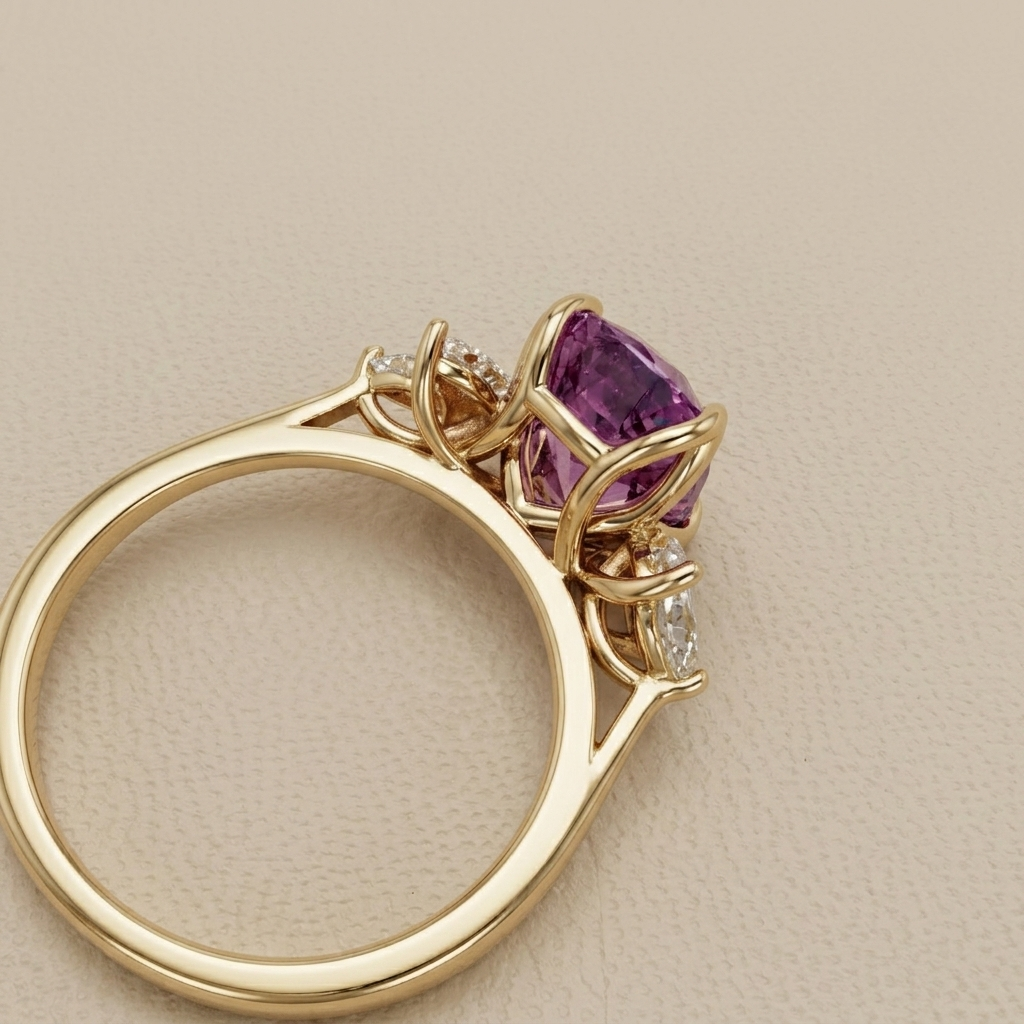
Six marquise diamonds, one deliberate frame
The mounting was designed around this sapphire — not pulled from a catalogue. Six marquise-cut diamonds (F color, VS clarity) extend the cushion’s geometry outward, their points directing the eye back to the pink center. Set against 14kt gold, F-color diamonds read icy white, and that contrast is precisely what makes the sapphire’s blush appear more vivid on the hand. It wears as an engagement ring or as a right-hand statement piece — sapphire’s hardness makes it a stone for every day, not for a safe.

08 — Questions Buyers Ask
Before you decide
Are unheated pink sapphires a good investment?
No gemstone should be bought purely as a financial instrument, but unheated sapphires occupy the strongest position in the sapphire market. Supply is fixed — treatment can’t be undone, and untreated rough grows scarcer each year — while demand from collectors keeps rising. Auction results consistently show unheated Ceylon stones outperforming heated equivalents by multiples, not percentages.
How does a pink sapphire compare to a pink diamond?
Natural pink diamonds of comparable size routinely sell for hundreds of thousands to millions of dollars — the Argyle mine that produced most of them closed in 2020. A fine unheated pink sapphire delivers the same romantic color language at a small fraction of that price, with hardness (9 on the Mohs scale) fully suited to daily wear. For most buyers it is the rational way to own natural pink.
Can I have this ring independently appraised or insured?
Yes — and you should. The ring ships with its original GIA Sapphire Origin Report (N° 1232891350), which is exactly the document insurers and independent appraisers want to see. Any appraiser can verify the report at reportcheck.gia.edu before you finalize coverage.
Is a 3-carat pink sapphire rare?
Pink sapphires are found far less often than blue, and most crystals are small. A clean, well-cut pink sapphire above three carats is uncommon; one that is also unheated, GIA-certified, and of Ceylon origin sits in the top tier of what reaches the market in any given year. This is why the ring is offered as a one-of-one — when it sells, we source a different stone, never a copy.
Can I see the ring before buying?
Yes. Private viewings are available by appointment at our Astoria, New York atelier (30-06 Steinway St), and we arrange video consultations for buyers outside the city. Call (718) 956-0001 or contact us online to book.
N° 1232891350 — Available Now
One stone. One ring. One owner.
Free insured shipping · Financing from $531/mo via Affirm · 30-day returns · Complimentary resizing · Private viewings in Astoria, NY
$8,500