
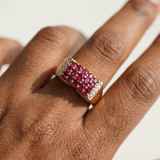
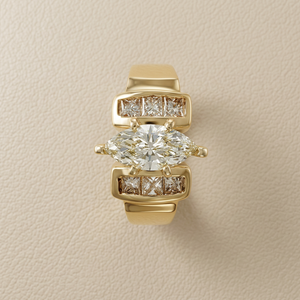
Vintage Ruby & Diamond Cocktail Ring — 0.99tcw | 14kt Yellow Gold
$1,450.00
Gold Diamond Gemstone Jewelry


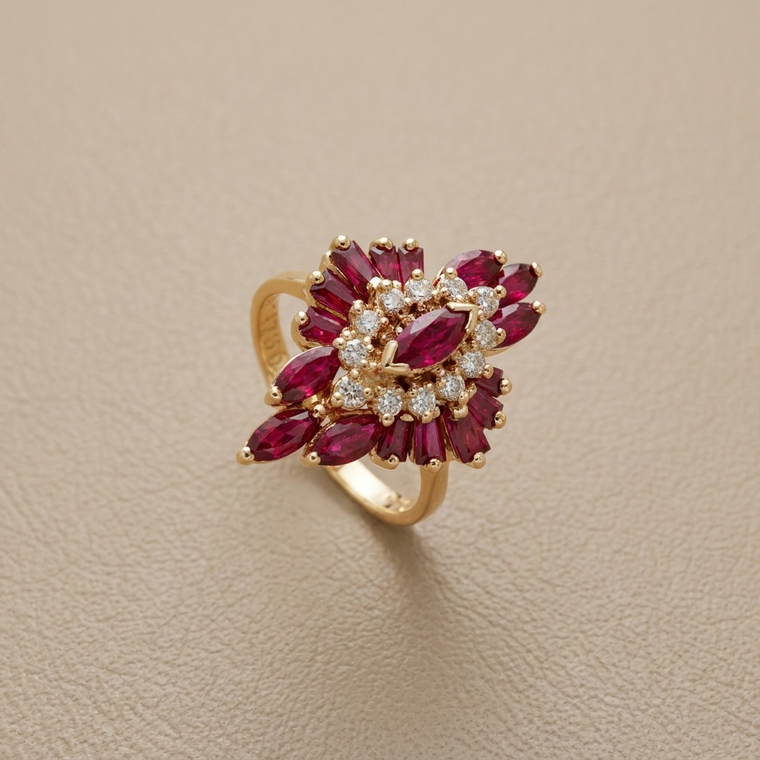
A vintage marquise ruby and diamond cocktail ring in solid 18kt yellow gold, combining three classic vintage design signatures in a single piece: a 0.70tcw marquise-cut ruby center stone, 0.50ct of tapered baguette ruby accents framing the shoulders, and 0.14ct of natural diamond accents adding sparkle to the geometry. Total carat weight 1.34tcw. The silhouette draws directly from the 1920s through 1950s American cocktail ring tradition — the marquise cut popularized in Art Deco and Retro period jewelry, the tapered baguette shoulders a hallmark of 1930s and 1940s ring construction, and the cocktail ring format itself a prohibition-era American invention. Set in 18kt gold rather than 14kt, this is a step above the typical catalog standard. Ruby is Mohs 9 — second only to diamond — making this a vintage piece durable enough for daily wear. $2,550. SKU: T&CO-0030.
The marquise cut, also called "navette" (French for "little boat"), is one of the most historically resonant gemstone shapes in fine jewelry. The cut originated in the 18th century French royal court — commissioned by King Louis XV to mimic the smile of the Marquise de Pompadour — and rose to definitive popularity in the Art Deco (1920s) and Retro (1940s) periods, when the elongated boat outline became a signature feature of American and European cocktail rings. For a ruby, the marquise cut does three specific things. First, it elongates the stone visually on the finger — a 0.70-carat marquise reads face-up larger than a round cut of equivalent weight. Second, the pointed ends direct the eye along the length of the ring, emphasizing the horizontal silhouette characteristic of vintage cocktail jewelry. Third, the long facet structure of the marquise cut lets ruby’s saturated red color read clearly through the length of the stone rather than being broken up by brilliant-cut faceting. The marquise is the definitive vintage ruby shape.
Flanking the marquise ruby are tapered baguette cut ruby accents totaling 0.50 carats. The tapered baguette — a step-cut rectangle that narrows toward one end — is a defining detail of 1930s and 1940s vintage ring construction, used specifically to create the geometric shoulder profile that transitions from the wider center setting down to the narrower band. In a ruby cocktail ring, tapered baguette ruby accents do something unusual: rather than framing the center stone with diamonds (the more common format), the ruby-on-ruby construction intensifies the red color block across the top of the ring for a bolder, more saturated presentation. This is a deliberately vintage construction choice — modern halo-style ruby rings typically use round diamonds in the shoulder position. The baguette ruby detail is one of the clearest markers of this ring’s vintage design language.
The ring is accented with 0.14tcw of natural round brilliant diamonds positioned to add targeted sparkle to the geometric framework without competing with the ruby color blocks. In vintage ruby cocktail rings, diamond accents serve a specific compositional role: they provide white-light brilliance points that contrast with the saturated red of the ruby, heightening the visual drama of the color arrangement. Too much diamond would dilute the ruby impact; too little would leave the geometry visually static. The 0.14tcw placement strikes the balance typical of high-quality vintage ruby and diamond cocktail rings from the mid-century period.
The ring is set in solid 18kt yellow gold, stamped 750 for purity. 18kt contains 75% pure gold by weight — meaningfully higher than the 58.5% (585 stamp) of 14kt gold that defines most commercial fine jewelry. For a vintage cocktail ring, 18kt yellow gold delivers two specific advantages. First, the warmer, richer gold tone of 18kt intensifies ruby’s red color through complementary contrast — the higher gold content creates a deeper yellow that makes the ruby read more saturated than it would in 14kt. Second, 18kt is more valuable per gram than 14kt, which positions this ring in the premium tier of vintage ruby cocktail jewelry: the metal alone represents a meaningful portion of the piece’s retained value over time. This is a 18kt vintage cocktail ring, not a 14kt fashion piece.
The cocktail ring format traces to 1920s American prohibition-era glamour. When society women attended illegal cocktail parties, the cocktail ring became a status signal: deliberately large, colorful, worn on the right hand, designed to catch light and attention across a room. Ruby was one of the definitive stones for the form from the beginning — the saturated red color, cultural associations with passion and luxury, and exceptional Mohs 9 durability made ruby the ideal cocktail ring center stone. The format continued through Art Deco, Retro, and mid-century American fine jewelry, with marquise ruby cocktail rings in particular becoming a defining silhouette of the era. This ring is a canonical example of that tradition — worn on the right hand, made to be noticed, built to survive decades of wear.
Ruby is one of the hardest gemstones on earth — Mohs 9, second only to diamond (10), tied with sapphire. Chemically, ruby is corundum (aluminum oxide), with chromium responsible for the red color and for the subtle inner fluorescence that gives fine ruby its signature glow under daylight. For a vintage cocktail ring worn regularly, ruby’s hardness is a meaningful practical advantage: vintage rings set with softer stones (emerald at 7.5–8, opal at 5.5–6, turquoise at 5–6) often show significant wear on the center stone after decades of use, whereas a vintage ruby retains its brilliance essentially indefinitely with basic care. Clean with mild soap and warm water, avoid harsh chemicals.
Ruby is the traditional gift stone for the 15th wedding anniversary and the 40th wedding anniversary. A vintage ruby cocktail ring is the canonical anniversary gift format for these milestones, and this piece specifically — 1.34tcw in solid 18kt yellow gold with marquise ruby center, tapered baguette ruby shoulders, and diamond accents — is configured as a significant-milestone heirloom piece rather than a casual fashion purchase. The 18kt gold construction adds meaningful retained value; the three-stone-type design adds visual interest that holds up to repeated wear; the vintage style language ages well across decades.
A vintage marquise ruby cocktail ring is a vintage-era fine jewelry piece built around a marquise-cut ruby center stone, typically with additional ruby or diamond accents and a substantial statement-ring silhouette designed for the right hand rather than the ring finger. The format emerged in the 1920s during American prohibition and continued through the Art Deco, Retro, and mid-century periods, with marquise ruby cocktail rings in particular becoming a signature silhouette because the elongated marquise cut paired naturally with the horizontal, geometric design language of 1920s through 1950s fine jewelry. Tapered baguette ruby or diamond shoulders are a hallmark construction detail of the 1930s and 1940s examples. At 1.34tcw with a marquise ruby center, tapered baguette ruby shoulders, round diamond accents, all set in solid 18kt yellow gold, this ring is a canonical example of the format — an 18kt heirloom cocktail ring in the vintage ruby tradition, built to be worn and passed down rather than admired only in a vault.
Gold Diamond Gemstone Jewelry





Gold Diamond Jewelry