
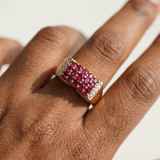
Vintage Ruby & Diamond Cocktail Ring — 0.99tcw | 14kt Yellow Gold
$1,450.00
Gold Diamond Gemstone Jewelry


An authentic vintage grey diamond ring in 14kt yellow gold, set with 0.46 carats of natural grey-colored diamonds in a combination of tapered baguette cuts and round cuts. SI2 clarity. The silhouette draws directly from the 1930s and 1940s American fine jewelry tradition — the era when tapered baguette accents paired with round brilliant cuts became one of the signature construction formats of Art Deco and Retro period rings. This is not a vintage-inspired reproduction; this is an actual vintage piece, manufactured in the period its design language references. SKU: AJDR-0040.
There is a meaningful distinction between authentic vintage and vintage-inspired fine jewelry, and buyers who know the difference tend to care about it significantly. Vintage-inspired rings are contemporary new production in a vintage aesthetic — manufactured recently but designed to look like older pieces. Authentic vintage rings are the original article: pieces actually manufactured in the era their design language references, carrying the physical construction characteristics, hand-finishing marks, and material signatures of that period. The two categories serve different buyers. Buyers who specifically want authentic vintage value the originality and historical continuity of a ring that has existed longer than they have, and they specifically do not want a reproduction. This ring sits in the authentic vintage category. The physical construction (tapered baguette + round cut combination in 14kt yellow gold) is characteristic of the 1930s through 1950s American fine jewelry tradition, and the natural grey coloration of the diamonds reflects authentic vintage-era diamond characteristics rather than contemporary machine-cut precision.
The ring is set with natural grey-colored diamonds. In vintage fine jewelry, grey diamond coloration is typically authentic — the result of natural mineral inclusions, structural characteristics, or specific mining sources from the early-to-mid twentieth century, rather than treatment or enhancement. Grey diamonds in vintage rings are not a defect; they are a characteristic that contemporary mass-market new production does not replicate, which is part of what makes authentic vintage pieces visually distinct from reproductions. The clarity grade here is SI2 (Slightly Included), which is consistent with vintage-era diamond grading where hand-cutting techniques retained more natural mineral character than contemporary laser-calibrated cuts. For buyers specifically drawn to the softer, more idiosyncratic optical personality of vintage diamonds over the uniform sparkle of modern production stones, the grey coloration and SI2 clarity together produce a specifically vintage aesthetic. Without original grading documentation we cannot classify these as fancy grey, salt-and-pepper, or any other specific contemporary designation — what we can confirm is that they are natural diamonds, grey in color, set in an authentic vintage ring.
The ring combines tapered baguette cut diamonds (step-cut rectangles that narrow toward one end) with round brilliant cut diamonds. This specific combination is one of the signature construction formats of 1930s and 1940s American fine jewelry, and it is strongly associated with the Art Deco (1920s–1930s) and Retro (1940s) design periods. The design logic is specific: the round brilliant cuts provide concentrated light-return centers, while the tapered baguettes provide architectural geometry and directional flow through the ring’s silhouette. Step-cut baguettes produce cleaner, more architectural light flashes than the scattered sparkle of brilliants, which makes the combination visually balanced rather than optically chaotic. Contemporary new production rarely uses this construction because it requires hand-calibrating multiple cut styles to work together, which adds manufacturing complexity that mass production avoids. Finding this format in an authentic vintage piece confirms the ring’s period construction.
The ring is set in solid 14kt yellow gold, stamped 585 for purity. 14kt yellow gold dominated American vintage fine jewelry manufacture from the mid-twentieth century forward — it was the standard commercial karat that balanced gold content with durability and affordability for the era’s retail market. For an authentic vintage ring, 14kt yellow gold is the most historically accurate metal: it places the piece squarely in the American commercial vintage tradition rather than European platinum or 18kt positioning. The warm yellow tone complements the natural grey diamond coloration through color contrast — yellow gold visually deepens and frames grey diamonds in a way that white metals cannot match.
Authentic vintage fine jewelry pricing stratifies by carat weight, clarity grade, maker provenance, and era-specific desirability. Substantial vintage engagement rings with verified provenance typically run $2,500 and up, often into five figures for signed pieces from named makers. Smaller authentic vintage pieces like this one — 0.46tcw with SI2 clarity grey diamonds in 14kt yellow gold — occupy the sub-$2,000 tier where buyers can own an actual vintage ring without the financial commitment of a larger statement piece. For a first-time vintage fine jewelry buyer, a vintage ring stacker, or someone specifically looking for authentic period construction over vintage-inspired reproduction, this ring delivers the authenticity of the category at a mid-tier price point of $1,500.
A vintage grey tapered baguette diamond ring is an authentic vintage fine jewelry piece featuring natural grey-colored diamonds set in a combination of tapered baguette and round cut configurations, typically in 14kt yellow gold, dating to the Art Deco (1920s–1930s) through Retro / mid-century (1940s–1950s) American fine jewelry tradition. The tapered baguette + round cut format was one of the signature construction styles of the period, and grey diamond coloration in vintage rings reflects authentic era-specific mining and cutting characteristics rather than contemporary treatment or enhancement. Vintage grey diamond rings remain a distinctive sub-category in the vintage fine jewelry market specifically because the grey coloration is not a design choice made in contemporary production — it is a period characteristic. At 0.46tcw in 14kt yellow gold with round cut and tapered baguette grey diamonds, this ring is an accessible-price-point example of the format suited to buyers who specifically want authentic vintage over vintage-inspired reproduction.
Gold Diamond Gemstone Jewelry


Gold Diamond Jewelry