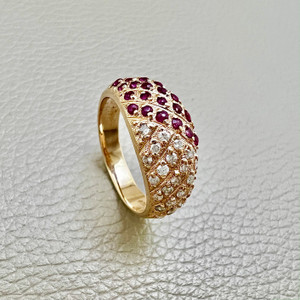
This tapered baguette ruby diamond ring centers an 0.84 ct tapered baguette-cut ruby - the cut narrows from one end to the other, creating directional motion across the face of the ring - flanked by 0.24 ct of round diamond accents in G/H color, SI1-SI2 clarity. The setting is 14K white gold, the cooler metal tone among our ruby ring inventory.
Total carat weight is 1.08 ct, sized 5 through 9, in solid 14K white gold (585 purity). This is the ruby-dominant ring in this batch - the ruby alone accounts for over 75 percent of the total carat weight, with diamonds providing white-light counterpoint rather than competing for visual attention. White gold lets the red ruby read more saturated than yellow gold would, making this design read more modern than vintage despite the cocktail-ring proportions.
Yellow gold has been the traditional metal for ruby rings since at least the Victorian era, but white gold creates a different effect: the cool metal does not compete with the warm red of the ruby, producing a higher-contrast presentation that reads more contemporary than antique. The tapered baguette is also less common than round or oval ruby cuts - it is essentially a custom-cut shape, since baguette is more often a diamond cut than a ruby cut. The 0.84 ct tapered baguette here is the centerpiece, and the 14K white gold setting gives it the visual prominence the cut deserves.
Yes. The 0.84 ct tapered baguette is a natural red ruby. The 0.24 ct of accent diamonds are also natural.
The accent diamonds are G/H color (near-colorless) and SI1-SI2 clarity (inclusions visible under 10x magnification, not typically to the unaided eye).
The tapered baguette is a step-cut shape that narrows from one end to the other, creating directional motion. It is less common in rubies than rounds or ovals, which makes this ring distinct from the more typical ruby ring formats. Step cuts also tend to favor stones with strong color saturation, which is the case here.
It can serve as one. Ruby is increasingly popular as an engagement-stone alternative to diamond, and the white gold setting reads modern enough to suit contemporary engagement preferences. The 1.08 ct tw and ruby-dominant proportions give the ring genuine engagement-scale presence.
White gold provides higher contrast against red ruby - the metal does not pick up the warm tone of the stone, so the ruby reads cooler and more saturated. Yellow gold has historically been the traditional pairing because it can deepen the perceived red, but white gold has become standard for buyers wanting a more modern presentation.