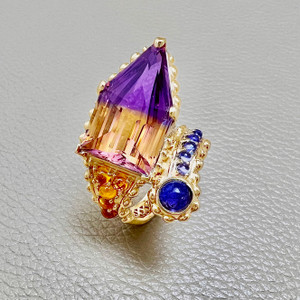


An emerald cut ametrine ring in 14kt yellow gold, set with a 5.22-carat natural bicolor ametrine from the Anahí Mine in eastern Bolivia — the only commercial source of ametrine in the world. The stone displays the characteristic bicolor signature of ametrine: amethyst purple transitioning into citrine gold within a single crystal, separated by a crisp boundary that the emerald cut is specifically designed to frame and showcase. At 5.22tcw this is a true statement ring — a substantial yet wearable cocktail or right-hand ring that carries visual weight without feeling heavy on the finger. $850. SKU: AJGR-0427.
Ametrine is a rare natural variety of quartz that combines amethyst (purple) and citrine (golden-yellow) within a single crystal. The two colors are formed by different oxidation states of iron — ferrous iron produces the amethyst zone, ferric iron produces the citrine zone — and the crystal structure holds both simultaneously, separated by a naturally sharp color boundary. Ametrine is one of only a handful of bicolor gemstones that occur naturally in nature, and the only one that commercially combines two extremely popular gemstone colors in a single stone. On the Mohs hardness scale, ametrine rates 7 — the same as amethyst, citrine, and all other quartz varieties — making it appropriately durable for rings worn daily.
The emerald cut is the ideal faceting choice for a bicolor stone like ametrine. Unlike brilliant cuts, which scatter light through many small facets and visually break up the color, the emerald cut uses long parallel step facets that preserve clean optical windows into the body of the stone. For ametrine specifically, this means the purple-to-gold color boundary remains sharp and visible — the stone reads clearly as bicolor rather than muddled or washed out. The emerald cut also elongates the stone visually on the finger, which helps a 5.22-carat gem sit elegantly without appearing bulky.
Commercial-quality ametrine comes from a single source in the world: the Anahí Mine in the Santa Cruz department of eastern Bolivia, near the border with Paraguay. The mine was brought to commercial production in the 1970s and remains essentially the only location producing gem-grade ametrine at scale. Although isolated ametrine deposits have been reported in Brazil and India, none produces commercial quantities of gem-grade material. This means that virtually every genuine natural ametrine sold worldwide — including this stone — traces back to a single remote mine in Bolivia, a degree of geographic exclusivity shared only by tanzanite and a handful of other single-source gemstones.
The ring is set in solid 14kt yellow gold, a metal choice that enhances the citrine (gold) side of the ametrine while providing warm contrast to the amethyst (purple) side. Yellow gold is traditionally the preferred metal for citrine and for bicolor stones with golden components, because the warm metal tone extends the golden zone’s optical presence while making the purple zone read more saturated by contrast. 14kt is the ideal karat for daily-wear settings — durable enough to protect the stone, lightweight enough for comfort, and more accessible in price than 18kt or platinum.
For buyers looking at an ametrine engagement ring or ametrine wedding ring alternative, the combination of substantial carat weight (5.22tcw), single-source geological rarity, and Mohs 7 hardness makes this a defensible daily-wear choice. Ametrine is increasingly chosen by buyers who want an engagement or right-hand ring that is genuinely one-of-one in color pattern — no two ametrine stones display exactly the same purple-to-gold boundary — and who prefer geological scarcity over traditional diamond conventions. Please see the FAQ below on ametrine durability and daily wear.
An emerald cut ametrine ring is a ring set with a step-cut rectangular ametrine as the center stone. Ametrine is a bicolor natural quartz combining amethyst and citrine in a single crystal, and the emerald cut is the preferred faceting style for ametrine because its long parallel facets preserve a clean optical view into the stone — keeping the purple-to-gold color boundary sharp and visible rather than broken up by faceting. Genuine ametrine is sourced from the Anahí Mine in eastern Bolivia, which is effectively the only commercial producer of gem-grade ametrine in the world. In a 14kt yellow gold setting, the warm metal enhances the citrine zone’s gold tone while making the amethyst zone read more saturated by contrast — producing the deep bicolor presentation that defines collector-quality ametrine.
Treasured & Co.®

Treasured & Co.®


